
Made Trade Alternatives for Ethical Home Goods
Last Updated: November 7, 2026
Quick Summary
Made Trade alternatives for home goods are smaller, more accountable sources such as local boutiques, regional makers, and curated micro boutiques that can name the workshop behind each piece. Score any store 1 to 5 on maker disclosure, material specificity, certification evidence, durability signals, and end-of-life plan, and treat a total under 15 out of 25 as a signal that verification will take more work.
- A real sustainable home decor brand names who made the item, what it is made from, and its end-of-life plan.
- A marketplace's score reflects its weakest seller, not its best, so small vetted boutiques often score higher.
- Price per use equals purchase price divided by expected years of use times uses per year.
- A fair trade certified claim should resolve to a registered producer or importer in the certifier's public registry.
- Dean + Hendrix price points run from a $16 porcelain ring holder to a $99 throw.
Table of Contents
- Why Shoppers Look for Made Trade Alternatives
- Sustainable Home Decor Brands: What Separates Real From Greenwashed
- Ethical Home Goods: A Criteria-Based Selection Framework
- Non-Toxic Home Decor: Materials, Finishes, and What to Ask
- Affordable Ethical Home Decor: Price-Per-Use and End-of-Life Value
- Comparison Table: Made Trade Alternatives at a Glance
- Verification Tools and Regional Sourcing: How to Check a Store's Claims
- Choosing Your Next Ethical Home Goods Purchase
- Frequently Asked Questions
Why Shoppers Look for Made Trade Alternatives
The search for a Made Trade alternative for home goods usually starts with a specific frustration: you want artisan-made decor without the guesswork of a single marketplace's inventory. This guide from Dean + Hendrix compares what a criteria-first approach looks like, so you can judge a store on sourcing, materials, and longevity rather than on marketing language.
Here is the core tension. Curated marketplaces built their reputation on supply chain transparency, then scaled into thousands of SKUs where that transparency gets thin. Shoppers notice. They start looking for smaller, more accountable sources: local boutiques, regional makers, and stores that can name the workshop behind a handmade piece.
Below, we break down what separates genuine sustainable home decor brands from greenwashing, build a selection framework you can reuse on any store, and show how to check a shop's claims before you spend. The stakes are practical: a well-made piece bought once and kept for a decade beats three cheap replacements, every time.
Sustainable Home Decor Brands: What Separates Real From Greenwashed
A real sustainable home decor brand can answer three questions without hesitation: who made the item, what it is made from, and what happens to it at end of life. A greenwashed brand answers with adjectives.
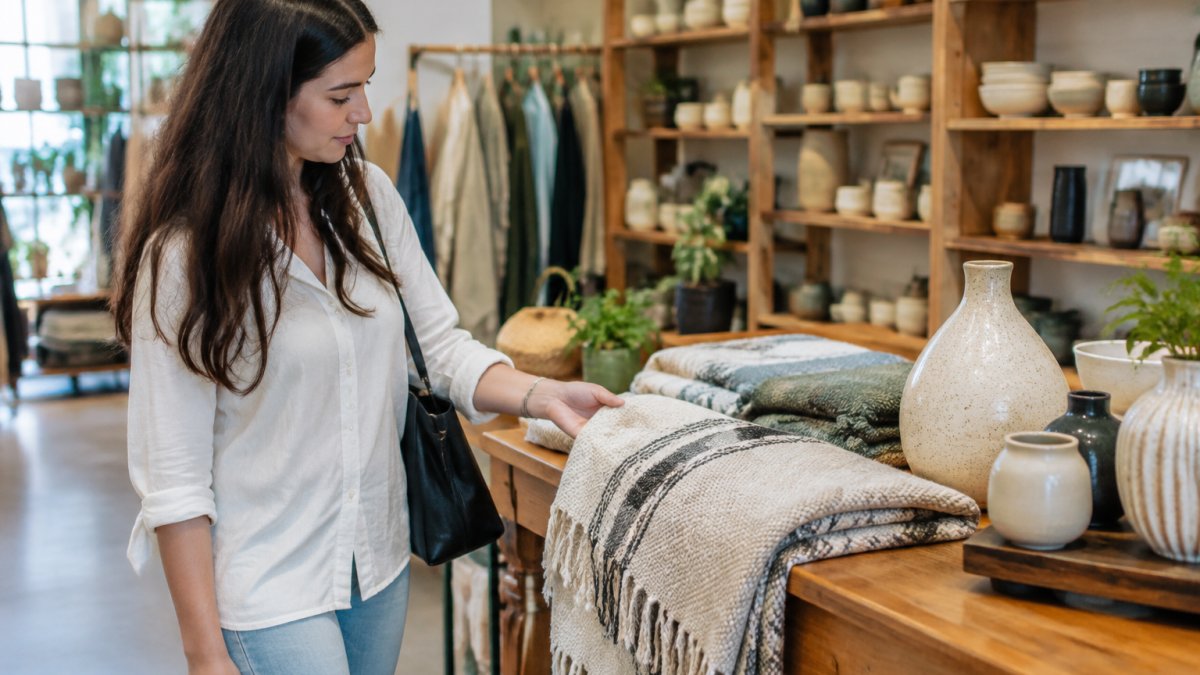
The most common mistake we see is treating a single label as proof. A "natural" tag means little on its own. Look for the certifying body's name, not just the word.
Watch out: a brand that leads with carbon footprint offsets while staying silent on ethical labor practices is usually optimizing the easier story. Offsets are purchasable; a living wage policy is not.
Ethical Home Goods: A Criteria-Based Selection Framework
Ethical home goods are products whose sourcing, labor, and materials can be verified against stated standards, not just described with eco-friendly language. Use the same five criteria on every store you evaluate.
Score each store 1 to 5 on these, and total it:
- Maker disclosure: Can you name the workshop or region of origin?
- Material specificity: Are fibers and finishes named, or left vague?
- Certification evidence: Is a certifying body named, with a registration you can check?
- Durability signals: Is construction described, or only styling?
- End-of-life plan: Does the store say how the item is repaired, refinished, or recycled?
A store scoring under 15 out of 25 is telling you something. That is not a moral verdict, just a signal that verification will take more work on your end.
This framework also solves the curated marketplace problem. A marketplace's score reflects its weakest seller, not its best. A small boutique that stocks only vetted makers often scores higher on maker disclosure simply because it knows every supplier by name.
Non-Toxic Home Decor: Materials, Finishes, and What to Ask
Non-toxic home decor means pieces finished without harmful off-gassing compounds, which matters most for textiles, candles, and anything that sits close to where you eat or sleep. The practical question is not "is it natural" but "what was it finished with."
For candles, the wax and wick tell you most of the story. Our Apricot + Herb Quench candle is a hand-poured soy wax candle with a natural cotton wick and phthalate-free fragrance, and our Golden Hour candle is a coconut wax candle with a cotton wick.
Our Confetti Ceramic Platter is listed as food safe, microwave safe, and dishwasher safe.
Affordable Ethical Home Decor: Price-Per-Use and End-of-Life Value
Affordable ethical home decor is not the cheapest option at checkout. It is the lowest cost per use over the item's life, plus whatever value you can recover when you are done with it. Most buying guides stop at the sticker price; this section runs the math and then follows the item to its end of life, which is the part almost no competitor covers.
Run the math before you buy:
Price per use = Purchase price ÷ (Expected years of use × Uses per year)
Work it through on a throw: a $99 throw used every evening for five years works out to roughly five cents per evening (99 ÷ (5 × 365) ≈ 0.054).
End-of-life value is the second half of the equation, and it is the half most guides skip. A piece that can be repaired, refinished, resold, or composted keeps residual value; a piece that goes straight to landfill does not. Upcycled materials and biodegradable natural fibers score well here. Slow furniture and circular economy thinking are the same idea applied to bigger pieces.
A practical end-of-life ladder, from best to worst:
- Landfill. The default for anything that cannot be repaired, resold, or recycled. Treat this as the outcome to design against.
If you are weighing whether ethical goods justify their cost at all, our honest review of whether boutique gifts are worth the price works through that question in detail.
Comparison Table: Made Trade Alternatives at a Glance
The table below compares the listed home goods by price and material.
| Item | Price | Material | Best For | End-of-Life Notes |
|---|---|---|---|---|
| Ring // Holder | $16 | Porcelain, clear glaze, gold leaf | Nightstand or entryway | Keepsake object, long-lived |
| Golden Hour Candle | $22 | Coconut wax, cotton wick | Gifting, everyday scent | Amber jar reusable |
| The Moon Candle | $24 | North American soy wax | Bathroom, spa mood | Glass vessel reusable |
| Apricot + Herb Quench Candle | $28 | 100% soy wax, cotton wick | Kitchen, hostess gift | Keepsake beverage glass |
| Confetti Cer Platter | $44 | Ceramic, food-safe glaze | Serving, everyday dining | Dishwasher and microwave safe |
| Lush Throw | $99 | Poly microfiber | Daily sofa use | Machine washable, durable |
| Patterned Faux Fur Throw | $99 | Poly microfiber | Styling an accent chair | Machine washable, durable |
| Bamboni Throw | $99 | 78% microfiber, 22% rayon from bamboo | Breathable year-round layer | Machine washable, gentle cycle |
Price
Best for: shoppers who want a small, named range they can inspect in person rather than an endless scroll.
Skip if: you need a full room refresh in one order. A curated boutique carries depth in a few categories, not breadth in all of them.
Verification Tools and Regional Sourcing: How to Check a Store's Claims
Verification is a five-minute job if you know where to look, and regional sourcing is the fastest way to shorten the supply chain you are verifying. This section gives you the specific registries to check, a reusable checklist, and a method for finding makers close enough to visit.
Start with the certifying body's own public registry, not the store's badge graphic. A fair trade certified claim should resolve to a registered producer or importer. The pattern is the same every time: the badge on the product page is marketing; the registry entry is evidence.
Then check the maker. A store serious about regional sourcing will name the workshop, the town, and often the technique. If the product page says only 'ethically made,' that is a category, not a fact.
A verification checklist you can reuse on any store:
- Does the certification badge link to the certifier's own site, not the brand's 'our standards' page?
- Can you find the producer or importer in the certifier's public registry?
- Does the product page name the workshop, town, or region of origin?
- Is the fiber or material content specific (e.g., '78% microfiber, 22% rayon from bamboo') rather than vague?
- Does the store publish care and repair guidance?
- Does the store say how the item can be recycled, refinished, or composted at end of life?
Search your own region for craft guilds, makers' cooperatives, and studio tours; a potter within driving distance is a shorter supply chain than a marketplace warehouse, and you can ask the maker directly about glaze chemistry and firing temperature. The trade-off is breadth: a local maker will not stock a full room, so pair a local source for statement pieces with a vetted small boutique for the rest.
Watch out: greenwashing often hides in certification-style logos that link to the brand's own 'our standards' page. A real certification links to the certifier, and the certifier's registry will name the producer.
For a step-by-step method you can apply to any store, our guide on how to verify artisan-made products before you buy walks through the checks in order.
If you are still mapping the landscape of marketplaces, our roundup of alternatives for gifts that feel personal covers a different set of options for the same shopper.
Choosing Your Next Ethical Home Goods Purchase
Conscious consumerism works best when it is specific. Pick one category, apply the five-criteria framework, and buy the piece that scores highest on maker disclosure and durability. That is how sustainable living becomes a habit rather than a one-off splurge.
At Dean + Hendrix, we offer a curated selection of home goods sourced from small and local businesses, in micro boutiques located in community hubs. Our price points run from a $16 porcelain ring holder to a $99 throw.
If you are furnishing a smaller space, our ideas for aesthetic home decor in small apartments show how to place a few good pieces well.
The challenge is not finding ethical home goods. It is finding them without a research project every time. Get started with Dean + Hendrix and browse our curated selection of home goods.
Frequently Asked Questions
What are the best Made Trade alternatives for home goods?
The best Made Trade alternatives depend on what you value most. If you want to verify ethical claims in person, look for curated boutiques that partner with small and local businesses, such as Dean + Hendrix, a curated boutique that partners with small and local businesses. If you prioritize non-toxic finishes, check product listings for phthalate-free fragrances and natural fibers. For affordable ethical home decor, compare price-per-use on durable items like throws and ceramics rather than chasing the lowest sticker price.
Where can I buy ethical and sustainable home decor?
You can buy ethical and sustainable home decor through curated marketplaces, fair trade certified brands, and local micro boutiques. Dean + Hendrix offers a curated selection of home goods, including ceramic platters, candles, and throws, sourced from small and local businesses.
What should I look for when shopping for ethical home decor?
Look for specific, verifiable claims rather than general sustainability language. Check for fair trade certification, organic textiles, non-toxic finishes, and named artisan partners. Also assess durability and end-of-life disposal: a well-made item that lasts a decade and can be repaired or recycled often has a lower environmental cost than a cheap alternative replaced yearly.
Are there non-toxic home decor brands?
Yes. Non-toxic home decor focuses on materials and finishes that avoid harmful chemicals. Look for candles made with 100% natural soy or coconut wax and phthalate-free fragrance oils, textiles made from natural fibers, and ceramics with food-safe glazes. Dean + Hendrix carries candles with cotton wicks and phthalate-free fragrance, plus a ceramic platter listed as food safe. Always read the product listing for material details rather than assuming a brand is non-toxic.
Where can I find affordable ethical home decor?
Affordable ethical home decor is less about the lowest price and more about price-per-use. A $99 throw used daily for years costs pennies per use, while a $20 blanket replaced every season costs more over time. Dean + Hendrix offers a range of price points, from a $16 handmade porcelain ring holder to a $99 throw, so you can support small businesses at different budgets. Compare product details before deciding what is truly affordable.
